


Battery vs. Generator: The Complete Washington Homeowner Guide
Battery vs. Generator: The Complete Washington Homeowner Guide
Quick Summary
- Batteries win on noise, emissions, maintenance, and integration with solar.
- Generators win on upfront cost and prolonged outages.

Table of contents:
- Why Washington homeowners need backup power
- How battery and generator systems work
- Cost
- Installation & setup
- Capacity & scalability
- Reliability & runtime
- Lifespan & warranty
- Maintenance
- Safety
- Noise pollution
- Air pollution
- Solar compatibility
- Washington incentives
- Which system is right for your home?
Why Washington Homeowners Are Installing Backup Power
Each year, the Washington grid gets more unreliable. Climate-related extreme weather and skyrocketing energy demand is putting unprecedented strain on an overloaded and aging electrical grid. As Seattle’s population grows and energy-intensive technologies advance, the frequency of outages will increase. Just last month, thousands of PSE customers lost power for multiple days due to strong winds and snow.
Washington homeowners want control over their energy. They’re looking for affordable, reliable backup power to keep them safe, powered, and protected when the grid goes down. The first step? Deciding between a backup battery and gas generator.
Both options can power your home’s essentials for a few days, or even longer under the right circumstances. Curious which is right for your home? Let’s dive in!
Backup Battery vs. Gas Generator: How Each System Works
Both batteries and generators are designed to power your home’s essential appliances and outlets during a grid failure, but they do so in very different ways.
How does a backup battery work?
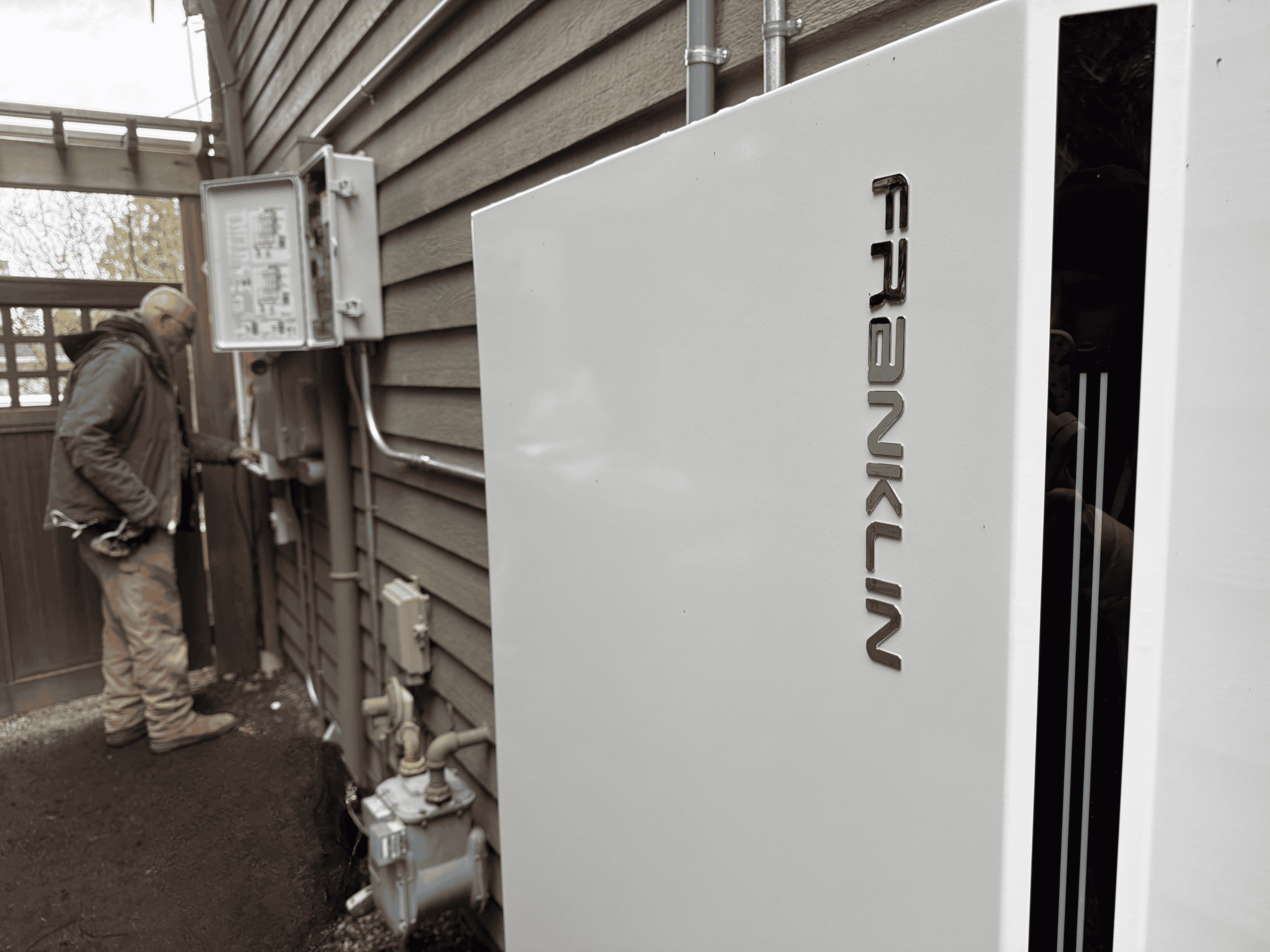
A home backup battery is installed as a wall-mount in your garage or on the side of your house and connects directly to your home’s electrical panel. It charges automatically throughout the day with electricity generated from your solar panels or the grid. When the grid goes down, it switches on instantaneously. To extend battery life during an outage, most homeowners switch off all non-essential breakers, keeping only the basics running: lights, the refrigerator, Wi-Fi, and a few outlets.
How does a gas generator work?
Rather than storing electricity, gas generators produce electricity on demand by burning fuel (typically gasoline, propane, or natural gas) to power an internal combustion engine that drives an electrical generator. The electricity produced can power your home either through a transfer switch (automatic or manual) that connects to your electrical panel, or via extension cords running directly to appliances. There are two main types of gas generators: portable and standby generators.
How do portable (manual start) generators work?
Portable generators are wheeled units you store in a garage or shed and manually start when the power goes out. They’re relatively affordable ($1,000–$3,000) and available at most home improvement stores, but require you to run extension cords or install a transfer switch and generator outlet to connect them to your home’s circuits. When an outage occurs, you’ll have to flip the transfer switch in the panel, wheel your generator outside (recommended 20 feet from your home), plug it in, and start it up.
They are powerful enough to energize your home’s essential circuits, but not provide whole-home backup. Because portable generators run on gasoline or propane, they require ongoing fuel management (both maintaining fresh fuel in storage and refueling during extended outages). When your generator runs low on fuel during an outage, you have to turn it off and let it cool before refueling.
They are louder (up to 90 decibels) than permanently installed standby generators due to their open-frame design, which leaves the engine exposed and lacks the sound-dampening enclosure found on standby units. They’re also vulnerable to theft, which isn’t really a concern for permanently installed systems.
How do standby (automatic start) generators work?
Standby generators are permanently installed outside your home and connected directly to your electrical panel via an Automatic Transfer Switch (ATS), which detects the outage and starts the generator automatically within 10–30 seconds. There will be a momentary loss of power during switchover. They run on natural gas or propane, and may require you to upgrade your fuel line upon installation. Typically sized between 12–26 kW, they’re capable of powering an entire home. Standby generators are significantly more expensive than portable generators, typically ranging from $8,000–$16,000+ fully installed. Runtime is theoretically unlimited as long as fuel is available.
The rest of this guide will focus on standby generators.
Backup Battery vs. Gas Generator: Cost
The upfront cost of a standby gas generator is typically cheaper than a backup battery, but installation is often more complex, raising costs. When it comes to maintenance costs, backup batteries are the clear winner. You’ll spend very little or nothing on upkeep and repairs, whereas a gas generator needs regular service to operate properly. Generators often look cheaper at purchase, but can cost just as much or more over the lifetime of the system.
Which system wins on cost?
✅Generator on installation costs (usually)
✅Backup battery on maintenance costs
Product & Installation Cost
Backup Battery Installation Cost
A professionally installed backup battery system in Seattle typically ranges from $12,000 to $25,000. Most Washington homeowners can expect to pay about $11,000 to $16,000 for the battery hardware and about $4,000 to $8,000 for installation. Another way to look at it is you can expect to pay $1,200 to $1,700 per kilowatt-hour (kWh) of storage capacity for the first battery and $700 to $1,000 per kWh for additional batteries. The cost per kWh decreases because the first battery includes fixed costs like installation, permitting, and the energy management controller, while additional batteries can share that same infrastructure.
A whole-home battery backup solution like the FranklinWH aPower 2 (10kW/15kWh) typically costs between $15,000 and $20,000 per unit fully installed, including the required aGate smart controller and labor.
Gas Generator Installation Cost
A typical standby generator is usually cheaper up front than a battery, but may have higher installation costs, including the concrete pad, automatic transfer switch, gas line connection, electrical work, and permits.
A professionally installed generator system in Seattle is typically $8,000–$16,000, with the average around $13,000. As of spring 2026, for a whole-home unit like the Generac Guardian 22kW, you can expect to pay about $6,000 to $7,000 for the generator and $3,000 to $8,000 or more for installation. A larger generator or complex installation can push costs above $20,000. It all depends on your home and energy goals.
Maintenance & Fueling Costs
Backup Battery Maintenance Costs
Batteries require little to no maintenance. Keeping the system in optimal working condition is often passive for the homeowner, with routine software and firmware updates pushed automatically by the manufacturer. A homeowner may want to complete an annual visual inspection to ensure there’s no damage to the battery and clean off any dust that may have collected, but they’re built to withstand the elements without it impacting battery health and performance. Homeowners can monitor their battery’s charge and capacity remotely through the manufacturer’s app.
Gas Generator Maintenance & Fueling Costs
A gas generator, on the other hand, requires regular maintenance and costs can really add up. For oil changes, filter replacements, and valve adjustments, Generac recommends service every 6 to 12 months by an authorized dealer. Spark plugs and the startup battery need to be inspected annually and replaced every few years. Generators also require transfer switch testing, coolant checks, and fuel system inspection, plus weekly 5–20 minute self-test cycles.
What do these costs look like over time? Seattle homeowners with a popular standby generator like a Generac 22kW Guardian may spend roughly $200–$600 per year on maintenance, plus additional fuel costs that vary with outage length, fuel type, and load. If the generator runs for about 25 hours total across five 5-hour outages, annual fuel costs could exceed $125 depending on whether the system uses natural gas or propane. Over 15 years, operating costs can add up to over $9,000, especially in Seattle where labor and fuel costs are higher.
When you consider the longview, batteries are often the smarter financial investment. A battery costs $0 to recharge when integrated with solar power. Gas prices will continue to climb over the next 15 years, making the lifetime cost of installing and operating a generator easily exceed $20,000 for many homeowners.
But Wait, How Much Does it Cost to Recharge a Battery?
While a backup battery does not require fuel, it does need to be recharged with energy from solar panels or the grid. When recharged with solar, it costs the homeowner $0, when recharged with grid power, it’s about $2 for homeowners living in Western Washington as of spring 2026. For example, to fully recharge a Franklin WH 15kWh aPower 2 would require about 16.7 kWh from the grid (you need to pull slightly more from the grid than you get back out). A Seattle City Light residential rate rate is approximately $0.139 per kWh. The math: 16.7 kWh x $0.139 per kWh = $2.32.
Backup Battery vs. Gas Generator: Installation & Setup
Backup batteries are typically simpler to install and set up, and have a much smaller square footage footprint than a gas generator.
- Battery backup: Wall-mounted in the garage or in a shady spot on the side of the house near the electrical panel; electrical work required like installing a transfer switch, smart electrical panel, and commissioning.
- Standby gas generator: Requires pouring a concrete slab, connecting the generator to a dedicated fuel source (such as installing a gas line), and electrical work like adding a transfer switch, plus device setup.
Which system wins on simplicity of install & setup? ✅Battery
Backup Battery vs. Gas Generator: Capacity & Scalability
A standard single-family home in Seattle consumes roughly 18–35 kWh per day, with essentials like lights, refrigerator, WiFi router, and some outlets accounting for 5–10 kWh of that usage.
Backup Battery Capacity & Scalability
A single 15 kWh battery can cover your home’s essentials for roughly 3 days without recharging, or indefinitely when paired with solar (under the right weather conditions).
Modular by design, backup battery systems can contain a single battery or stack multiple batteries, depending on your storage needs. Solterra Solar installs the Enphase IQ Battery 10C (customizable in 10 kWh increments from 10–80 kWh) and both the FranklinWH aPower S and aPower 2 batteries (customizable in 15 kWh increments). Homeowners or businesses with higher energy demands can add up to 15 batteries to their Franklin WH system.
Some homeowners want to be able to power their electric heating system or AC unit(s) during an outage. The FranklinWH aPower 2 features a continuous output of 10 kW, enough to start a 5-ton AC unit while running essential home loads without tripping or overloading. A homeowner might install multiple FranklinWH batteries if they want to power heat or cooling systems for several hours per day.
Standby Generator Capacity & Scalability
Standby generator units vary in size, with larger units designed to carry heavier loads for homes with more “essential” appliances, such as a central AC unit. When comparing a single battery to a single generator, a generator will typically be more capable of handling more high-power systems like heaters and AC units. For example, the Generac 22kW Guardian puts out significantly more continuous power (22kW) than the FranklinWH aPower 2 (10kW).
Fun fact: You can even pair batteries and generators together for even more coverage. The FranklinWH aPower 2 has a generator has a place to plug in a generator to recharge it.
Which system wins on capacity and scalability? ✅ Tie: A whole-home generator will usually output more continuous power than a single whole-home battery, which makes a difference in parts of the country where central AC is considered “essential.” However, the ability to stack multiple batteries in a single backup system closes this competitive gap.
Backup Battery vs. Gas Generator: Reliability & Runtime
Reliability can be measured in a few ways: response time, long-term operation, and maintenance requirements. Batteries excel in terms of their reliable, instantaneous startup and low maintenance requirements, but gas generators are better suited for long-term outages.
Response time
- Battery backup: Instant; imagine not noticing you lost power
- Gas generator: Take 10–30 seconds to start, which can be an issue for sensitive electronics
Long-term operation
- Battery backup: Ideal for short- to medium-length power outages, but can be extended when recharged by solar. A typical whole-home backup battery can power a home’s essentials for 1–3 days without a recharge.
- Gas generator: Can typically carry heavier loads (like multiple AC units) and are better for prolonged grid failures with adequate fuel supply and proper maintenance.
- Exception: In case of extreme, prolonged grid failure or natural disaster, gas lines may be disrupted, making solar energy a more reliable and accessible source.
Maintenance requirements
- Battery backup: Minimal to no maintenance; charge can be monitored remotely through the app
- Gas generator: Regular maintenance and annual service by certified professional; gas levels must be monitored manually
Which system wins on reliability? ✅ Tie: Power outages in the Pacific Northwest are typically short duration (1–3 days), which a battery can handle effectively. However, the rare multi-day outage during Washington’s dark winter months would most likely lead to a drained battery that can’t be sufficiently recharged by solar due to short, cloudy winter storm days.
Backup Battery vs. Gas Generator: Lifespan & Warranty
How long does each system last? On the whole, standby gas generators have a longer lifespan, but shorter warranty period, compared to backup batteries.
- Battery backup: Usually have a 10–15 year warranty and are often designed to last about that long
- Gas generator: Typically have a 5-year warranty, but can last 20–30 years with good maintenance
Batteries lose some storage capacity over time. Popular models like the FranklinWH aPower S and Enphase IQ Battery 10C come with industry-leading 15-year warranties (or 6,000 cycles/60 MWh throughput, whichever comes first). They guarantee the battery should still have at least 70% of its original storage capacity at the end of the warranty period.
Generators have replaceable maintenance parts like batteries, filters, hoses, and some electrical components, but the engine, alternator, bearings, rotor, or controller can eventually wear out. Around 20 years, repairs can become so expensive or parts can be so hard to get that replacing the whole unit often makes more sense.
When considering system longevity, gas generators seem to come out on top. However, it’s important to factor in the fuel and maintenance costs for years 15–30, especially with gas price hikes. In the end, replacing a backup battery at year 15 may lead to lower costs and better warranty coverage over a 30-year window.
Which system wins on lifespan & warranty? ✅ Tie: generator wins on lifespan, and battery wins on warranty
Backup Battery vs. Gas Generator: Maintenance
Batteries require significantly less maintenance than gas generators. Most importantly, battery “maintenance” is largely passive on the homeowner’s part, whereas a gas generator requires regular service by a certified professional.
- Battery backup: Automatic software and firmware updates, annual visual inspection, and monitoring the battery’s capacity through the app (if desired).
- Gas generator: Every 6-months to a year, generators require oil and filter changes, valve adjustments, coolant checks, fuel system inspection, and more. Every few years, generator spark plugs and startup batteries need to be replaced.
When it comes to maintenance, a gas generator cannot compete with a home backup battery system.
Which system wins on maintenance? ✅Battery (by far)
Backup Battery vs. Gas Generator: Safety
Both systems are safe when properly installed and used, but gas generators do come with more likely and immediate risks.
Backup battery safety
Most home batteries are made of lithium iron phosphate (LFP). LFP battery technology provides enhanced safety due to stable chemistry and exceptional thermal stability. It is extremely rare for a home battery to overheat and catch fire, even under extreme conditions, when installed by a trusted, certified battery installer.
Gas generator safety
Gas generators pose immediate safety risks if installed or used improperly. They must be placed outdoors far away from windows, doors, and HVAC intakes to avoid carbon monoxide poisoning, which has caused many fatalities. Generators also carry fire risks from fuel leaks, hot exhaust, and electrical faults, plus shock hazards if wiring is improper.
Which system wins on safety? ✅Battery
Backup Battery vs. Gas Generator: Noise Pollution
- Battery backup: Near-silent operation
- Gas generator: Typically between 50–85 dBA
It’s no secret gas generators are noisy. Similar to a riding lawnmower, a standby gas generator can run as loud as 85 dBA (loud enough to cause hearing loss with prolonged exposure).
Manufacturers usually measure generator noise from 23 feet away, so the quoted numbers are lower than what you’d hear standing beside it. Portable units typically have ratings of 70–90+ dBA because their engines are exposed, whereas standby generators (60–70 dBA) use insulated, permanent enclosures to dampen sound.
For example, the Generac Guardian series noise ratings average around 67 dBA, or equivalent to a washing machine, slightly loud conversation, or background music at a restaurant.
For homeowners concerned about disturbing their neighbors, noise is a major selling point for the backup battery. Backup batteries are near-silent, except for the occasional low-level electronic hum or cooling fan noise. For example, the FranklinWH aPower 2 never exceeds 30 dB (quiet as a whisper).
Which system wins on noise pollution? ✅Battery (by far)
Backup Battery vs. Gas Generator: Air Pollution & Climate Impact
Backup batteries do not emit exhaust or air pollutants while in use, but gas generators do. This is why gas generators are required to be placed outdoors, away from windows, HVAC intake, and doors, to protect people from the toxic exhaust.
- Battery backup: zero local exhaust emissions during operation
- Gas generator: direct combustion emissions while running, including carbon monoxide, nitrogen oxides, carbon dioxide, and other pollutants
Many homeowners opt for a backup battery because it’s much cleaner for neighborhood air quality, especially during outages when generators may run for many hours.
Beyond local environmental impact, a battery’s overall climate footprint depends on how it’s charged. In Western Washington, most of our grid electricity comes from hydropower. While it offers cleaner electricity compared to burning fossil fuels, hydropower can have severe local environmental impacts on river ecosystems and salmon habitat.
When we take the longview, a battery is the greener choice even in areas where the grid is powered by fossil fuels. Why? Grid power has the capacity—and is already—becoming cleaner over time, but gas generators will always burn fuel and contribute greenhouse emissions while in use. Seattle homeowners committed to lowering their environmental impact should seriously consider pairing a home solar system with a backup battery.
Which system wins on air pollution? ✅ Battery (by far)
Backup Battery vs. Gas Generator: Works with solar?
If you’re interested in installing solar on your home, a backup battery is the smarter choice. Backup batteries integrate seamlessly with solar, storing the excess energy your panels produce during the day so it’s ready exactly when you need it: at night, during peak demand, or in case of grid failure. Homeowners pair solar with a backup battery for unrivaled energy freedom.
A gas generator can recharge a home backup battery like the FranklinWH aPower 2, but it does not integrate or “work with” solar. At best, it can offer redundancy as a backup to your backup.
Why pair a backup battery with solar?
- Protect your home & family during an outage: Power outages are on the rise due to more frequent extreme weather, rapidly aging electrical infrastructure, and unprecedented demands on the grid.
- Unlock solar power potential: Instead of sending it back to the grid, store the excess energy your panels produce to use at night, during peak demand, or when the grid is down.
- Unrivaled energy freedom: Keep your panels producing and your home powered by safely “islanding” when utilities fail with integrated battery storage.
Which system wins on solar compatibility? ✅Battery
Backup Battery vs. Gas Generator: Washington Incentives
Batteries clearly outshine gas generators when it comes to incentives. Washington state does not offer incentives for gas generators, but does offer clean energy incentives and utility rebates that can cut thousands off the cost of a battery install.
- State Sales Tax Exemption: When paired with solar, you won’t pay state or local sales tax on your system, cutting thousands off your total cost (expires in 2029).
- PSE Flex Battery Program: Get financial rewards for helping stabilize Washington’s energy grid with your home backup battery system. Enroll and earn up to $1,000 per battery, plus up to $500 per battery each year with no action required.
- PSE Enhanced Incentives: Receive up to $10,000 towards the upfront cost of your battery if you qualify. Earn up to $1,000 per battery plus $.50 per kWh for your participation during Flex events.
Washington programs focus on electrification and grid-supportive storage, not fossil fuel backup.
Which system wins on incentives? ✅ Battery
Which system is right for your Washington home?
Energy resilience in Washington doesn’t have to be complicated. Since 2010, Solterra Solar has installed thousands of home backup battery systems across Western Washington. We can help you explore if a backup battery or gas generator makes more sense for your home and energy goals. Get started by requesting a free battery quote today — one of our battery experts will reach out within one business day to help you find the right solution.
Author Bio:
 Sarah Taylor (she/her) is a writer and marketer dedicated to creating positive change through the power of story. With nearly a decade of experience helping mission-driven organizations connect with their audiences, she blends utility, empathy, and artistry to craft content that drives meaningful growth. Specializing in climate tech and environmental advocacy, Sarah turns passive viewers into loyal brand advocates by fostering deeper, more authentic online experiences. She holds an English and creative writing degree from Gonzaga University. When she isn’t poring over words with hot tea in hand, you can find her exploring the PNW’s unrivaled wild spaces or gently persuading her indoor cat, Lemon, to embrace life as an adventure cat.


